
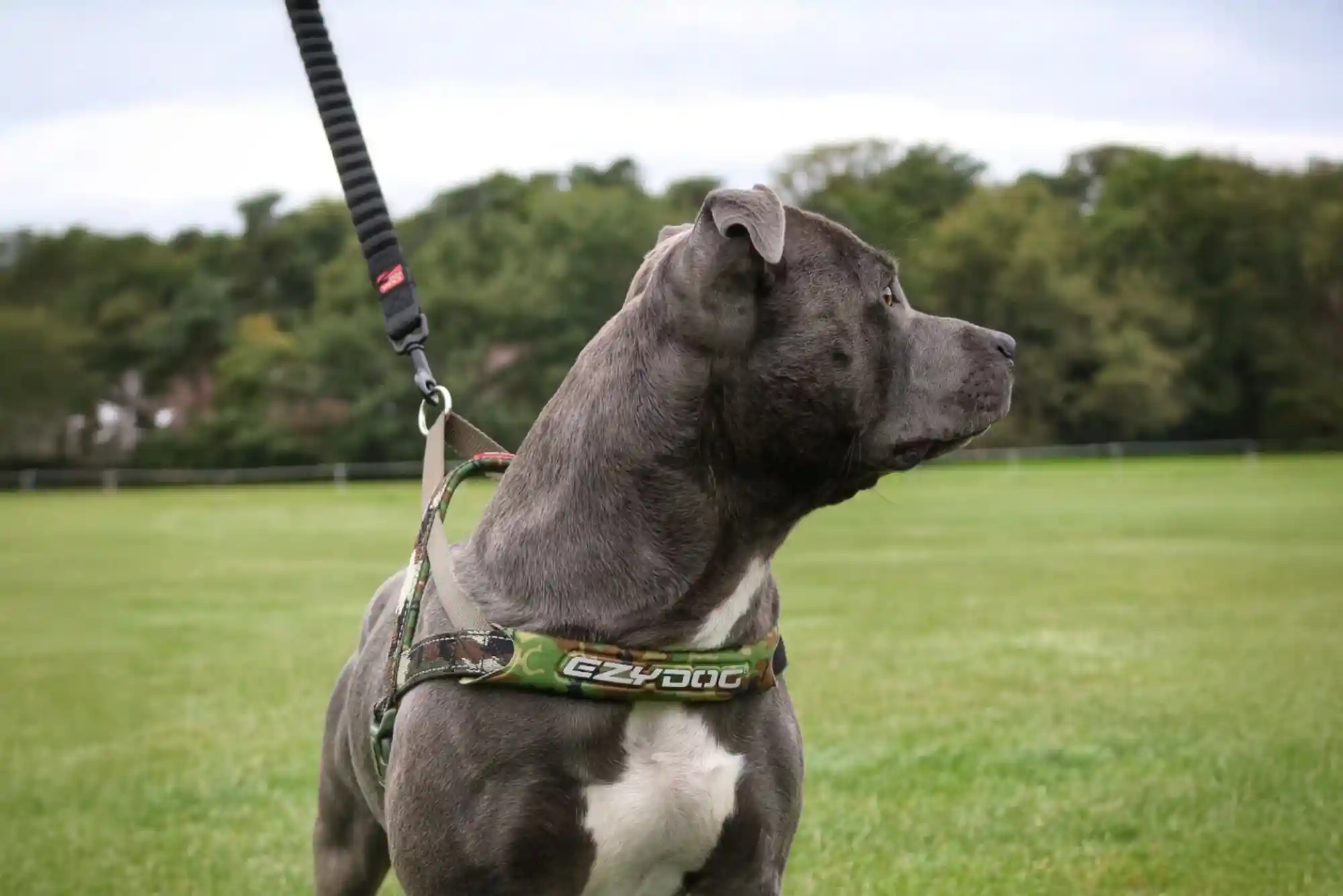

Introduction
Walking a powerful dog should not feel like a constant tug-of-war. Pitbulls, Boxers, and other strong pullers can generate surprising force, especially when they see another dog, a squirrel, a cyclist, or something else exciting. Choosing one of the best heavy duty no-pull harnesses can give you better control while reducing pressure around the neck.
A good harness, however, is not a magic solution. The right design should fit securely, distribute pressure appropriately, provide dependable attachment points, and work alongside reward-based leash training. Current harness comparisons consistently distinguish between everyday padded harnesses, simple front-clip designs, and dedicated no-pull systems designed for harder pullers.
For owners dealing with a strong dog, the goal is not simply to find the strongest piece of equipment. It is to find a harness that gives you control without sacrificing your dog’s comfort or freedom of movement.
Why Heavy Duty No-Pull Harnesses Matter for Strong Dogs
A strong dog can make an ordinary back-clip harness surprisingly difficult to manage. When the leash attaches at the dog’s back, the dog can often lean into the harness and use its body weight to maintain forward momentum. This is particularly noticeable with muscular, athletic breeds.
A front-clip no-pull harness changes that leverage. When the dog moves forcefully forward, the leash attachment point at the chest can redirect the body instead of allowing the dog to put its full strength directly behind the leash.
That does not mean every front-clip harness will automatically stop pulling. Rather, it makes pulling less mechanically efficient while giving the handler more steering control. The training still has to teach the dog what behavior earns rewards.
For very strong dogs, durability matters just as much as the no-pull mechanism. Buckles, stitching, webbing and attachment rings need to withstand repeated tension. A harness that looks sturdy but has poor adjustment or weak hardware is not a good choice simply because it is marketed as “heavy duty.”
What Makes the Best Heavy Duty No-Pull Harnesses?
The best heavy duty no-pull harnesses combine several qualities instead of relying on one feature.
Strong Construction
Look for robust webbing, secure stitching and high-quality hardware. Strong dogs can put considerable force through the leash, so the harness should not feel flimsy when you handle it.
However, “heavy duty” should not mean excessively bulky. A harness can be strong while remaining reasonably lightweight and comfortable.
A Reliable Front Attachment
For a dog that pulls, the front chest attachment is one of the most useful features. It can redirect forward momentum and make it easier to turn the dog toward you.
Dual-clip designs can provide additional versatility because they allow the owner to use the front attachment for control or the rear attachment for more relaxed walking.
Secure Adjustability
Pitbulls and Boxers can have muscular, deep or broad chests that make sizing particularly important. A harness should sit securely without becoming restrictive.
A poorly fitted harness can rotate sideways, rub behind the front legs, or potentially allow a determined dog to back out of it.
Comfortable Pressure Distribution
The harness should distribute leash pressure across appropriate areas of the chest and torso rather than concentrating force on the throat. Proper fitting remains essential; even a well-designed harness can cause discomfort if it is too tight or positioned incorrectly.
Best Heavy Duty No-Pull Harnesses for Pitbulls
Pitbull-type dogs are powerful, muscular and often remarkably athletic. Their strength makes harness construction and fit especially important.
The 2 Hounds Design Freedom No-Pull Harness is frequently positioned as a strong-puller option because it combines a front attachment with a martingale-style loop and can be used with a double-ended leash. Current reviews describe the design as particularly useful when a dog can overpower simpler front-clip equipment.
Its advantage is not simply that it is “strong.” The two-point configuration can provide additional steering and control while the martingale mechanism responds when the dog surges forward.
For a Pitbull that pulls hard but is otherwise manageable, a padded dual-clip harness such as the Ruffwear Front Range can also make sense. It provides front and back attachment options and places greater emphasis on everyday comfort. Current comparisons describe the Front Range as a premium everyday harness rather than an extreme-control tool.
The important consideration is your dog’s individual shape. Measure the chest carefully instead of buying according to breed alone.
Best Heavy Duty No-Pull Harnesses for Boxers
Boxers present a slightly different fitting challenge. Their athletic build and deep chest can make a poorly designed harness shift during energetic walking.
A front-clip or dual-clip design is generally more useful for a Boxer that pulls because it gives the handler an opportunity to redirect the dog rather than simply allowing it to lean forward.
The 2 Hounds Design Freedom is particularly worth considering when the Boxer is a committed puller. Its dual-point setup provides more steering than a conventional back-clip harness. Meanwhile, the Ruffwear Front Range is a reasonable choice when comfort, everyday walking and outdoor activities are higher priorities than maximum pull control. Current 2026 comparisons identify both designs as useful for different levels of pulling.
Because Boxers are active dogs, also consider how the harness behaves when the dog changes direction, trots, climbs stairs or plays. A harness should remain stable without interfering with normal shoulder movement.
Heavy Duty Harnesses for Dogs That Pull Extremely Hard
Some dogs are not simply enthusiastic walkers. They hit the end of the leash with enough force to move their handler several steps.
In these cases, the best heavy duty no-pull harnesses should provide both control and security.
A dedicated no-pull system with front and rear attachment points can be more useful than a basic back-clip harness. A double-ended leash can allow the handler to connect to two points simultaneously, providing greater steering and reducing the dog’s ability to lean directly into one attachment point.
The 2 Hounds Design Freedom is one example of this approach. Its martingale loop and two attachment points are designed to provide additional redirection when the dog surges.
Another option is the Kurgo Enhanced Strength Tru-Fit, which combines a front no-pull attachment with a more substantial construction and additional travel functionality. Current comparisons place it among options for owners who want a strong harness that can also be useful beyond ordinary walking.
Still, equipment should never be used as a substitute for professional help when a dog is genuinely dangerous to handle. If your dog repeatedly lunges at people, dogs, vehicles or other triggers, consider working with a qualified force-free trainer or veterinary behavior professional.
How to Choose the Right Harness for Your Dog
The best harness on paper is not necessarily the best harness for your individual dog.
Start with accurate measurements. Follow the manufacturer’s sizing instructions and measure the dog’s chest rather than guessing from weight or breed. A Pitbull weighing the same as another Pitbull may have a very different chest shape.
Once the harness is fitted, check that it stays stable while your dog walks. It should not slide dramatically from side to side or rub continuously behind the front legs.
You should also inspect the leash attachment hardware regularly. Look for frayed webbing, damaged stitching, cracked buckles or distorted metal rings. Heavy-duty equipment still needs maintenance.
For dogs that are particularly good at escaping, security deserves extra attention. A harness that fits loosely around the chest may become easier to back out of when the dog reverses direction.
No-Pull Harnesses Do Not Replace Leash Training
This is one of the most important points for owners to understand.
A no-pull harness changes the mechanics of pulling, but it does not teach a dog how to walk politely. If your dog learns that pulling eventually gets them closer to another dog, a person, a smell or a favorite destination, the behavior can continue regardless of equipment.
The most effective approach is to combine appropriate equipment with consistent training. Reward your dog for walking beside you, checking in voluntarily and keeping the leash loose.
Start somewhere quiet before expecting excellent behavior on a busy sidewalk. Reward frequently at first, then gradually increase the distance between rewards as your dog understands the exercise.
For additional guidance on preventing leash pulling, see Whole Dog Journal Pulling Prevention.
How to Introduce a Heavy Duty No-Pull Harness
Do not put a new harness on your dog and immediately head into the busiest environment you can find.
Let the dog investigate the harness first. Offer treats while showing it, then gradually allow the dog to wear it indoors for short periods.
Watch the dog’s body language. Scratching, freezing, excessive pawing or repeated attempts to remove the harness can indicate that the fit or introduction needs adjustment.
Once your dog is comfortable, begin with short walks in a low-distraction area. Use rewards whenever the leash remains loose or the dog voluntarily walks near you.
Gradually introduce more difficult environments. This makes the harness part of a larger training process rather than relying on equipment alone.
Common Mistakes When Using No-Pull Harnesses
One common mistake is buying a harness that is too large because the owner wants to give the dog “more room.” Excess movement can actually make the harness less effective and less secure.
Another mistake is assuming that a heavy-duty harness should be extremely tight. Tightness is not the same as security. The harness needs to be snug enough to remain correctly positioned without restricting breathing or normal movement.
Owners also sometimes continue walking forward while the dog pulls. If pulling consistently produces forward progress, the dog has little reason to change the behavior.
Instead, teach the dog that loose-leash walking is what makes the walk continue. Stop, redirect or change direction when appropriate, then reward the desired behavior.
If a dog has caused or suffered an injury during a walk, professional veterinary attention may be appropriate. For urgent situations, you can use the Emergency Pet First Aid Hub to locate emergency veterinary resources.
Are Expensive Heavy Duty Harnesses Always Better?
Not necessarily.
Price can reflect better materials, more adjustment points, stronger hardware, padding or more refined construction. But an expensive harness that does not fit your dog correctly is still a poor choice.
A moderately priced harness with a suitable front attachment and excellent fit can outperform a premium model that rotates or allows the dog to escape.
When comparing products, think about durability, fit, attachment configuration and your dog’s behavior rather than focusing only on the brand name.
For additional pet-related resources and local information, Uaefinders can also be useful.
Are No-Pull Harnesses Safe for Strong Dogs?
A properly fitted no-pull harness can be a practical alternative to attaching a leash directly to a collar, particularly for dogs that pull strongly. The critical issue is how the harness fits and where it places pressure.
Avoid using equipment that causes obvious pain, restricts normal movement or creates persistent rubbing. No-pull equipment should help you manage the dog, not punish the dog for moving forward.
If your dog has respiratory, orthopedic or other health concerns, speak with your veterinarian about appropriate walking equipment.
Choose Control, Comfort, and Training
The best heavy duty no-pull harnesses are not simply the thickest or most expensive models. They are the ones that combine dependable construction, secure fit, useful leash attachment points and enough comfort for your dog to move naturally.
For powerful Pitbulls, Boxers and other strong pullers, front-clip and dual-clip designs can provide valuable mechanical advantages. Dedicated systems such as the 2 Hounds Design Freedom may suit dogs that need greater redirection, while an everyday padded design such as the Ruffwear Front Range may be preferable when comfort and versatility are the priority.
Most importantly, pair the harness with patient, reward-based leash training. The equipment gives you better control today; consistent training helps create better walks tomorrow.
Frequently Asked Questions
What is the best no-pull harness for a strong dog?
There is no single best harness for every strong dog. A dedicated dual-clip system such as the 2 Hounds Design Freedom can be useful for committed pullers, while the Ruffwear Front Range is better suited to owners prioritizing everyday comfort and versatility. Current comparisons similarly distinguish the two based on control versus everyday use.
Do no-pull harnesses really stop dogs from pulling?
They can reduce the mechanical advantage a dog gets from pulling, particularly when using a front attachment, but they do not automatically teach loose-leash walking. Training and reinforcement are still necessary.
Are front-clip harnesses better for dogs that pull?
A front clip can provide better steering and redirection than a traditional back clip because forward force is redirected toward the chest. This can make strong dogs easier to manage while training.
What size harness should I get for a Pitbull?
Choose the size according to the manufacturer’s chest or girth measurement rather than breed or weight alone. Check the harness after fitting to make sure it remains stable and does not rub or restrict movement.
Can a strong dog break a no-pull harness?
Any harness can eventually fail if it is damaged, incorrectly fitted or subjected to unusual force. Inspect stitching, webbing, buckles and attachment points regularly, particularly if your dog is a powerful puller.
Is a no-pull harness better than a collar?
For a dog that pulls strongly, a properly fitted harness can reduce the concentration of leash pressure around the neck. However, the ideal setup depends on the dog’s health, behavior, training needs and individual fit.