
Introduction
Taking your dog for a walk while pushing a stroller can be enjoyable, but it can also become stressful when your dog pulls ahead, crosses in front of the wheels, stops suddenly, or lunges at people and other animals. Learning how to train a dog to walk beside a stroller is about more than teaching a simple heel. Your dog needs to understand how to move calmly beside a moving object while responding to your cues and remaining aware of the stroller.
The good news is that most dogs can learn this skill with patience, consistency, and carefully controlled practice. The safest approach is to introduce the stroller gradually, reward calm behavior, and increase distractions only when your dog is ready. Whether you have a puppy, an energetic adult dog, or a strong puller, the same basic training principles can create safer and more enjoyable walks.
Why Training Your Dog to Walk Beside a Stroller Matters
A stroller changes the dynamics of an ordinary dog walk. You have one hand occupied with steering, the stroller takes up additional space, and your dog has less freedom to move unpredictably around you.
A dog that normally walks reasonably well may suddenly pull toward squirrels, bark at passing dogs, or move directly in front of the stroller. That creates a risk of tangled leashes, sudden stops, or the stroller running into your dog.
When learning how to train a dog to walk beside a stroller, the goal should not simply be to keep the leash tight or physically control the dog. Instead, teach your dog that staying in a predictable position beside you is rewarding and safe.
Good stroller walking also gives your dog a clear job. Rather than constantly deciding where to go, your dog learns to follow your pace, pay attention to your signals, and ignore common distractions.

For additional safety information, owners can also review the AKC Stroller Walking Guidelines for general guidance on exercising dogs around strollers.
Start With Basic Leash Skills
Before introducing a moving stroller, make sure your dog understands basic loose-leash walking. If your dog regularly pulls during normal walks, attempting stroller training immediately can make the process unnecessarily difficult.
Practice walking in a quiet area where your dog can concentrate. Hold the leash comfortably and reward your dog whenever they walk near your preferred position without pulling.
You do not need your dog to walk in a competition-style heel. For most stroller walks, a relaxed position slightly beside and behind the stroller handle is practical. The important thing is that your dog does not move directly in front of the wheels.
Choose a simple verbal cue such as “with me,” “close,” or “let’s go.” Say the cue calmly and reward your dog when they respond by moving into the desired position.
Keep early sessions short. Several five-minute training sessions can be more productive than one long session in which your dog becomes frustrated or distracted.
Introduce the Stroller Before Moving It
One of the most important steps in learning how to train a dog to walk beside a stroller is allowing your dog to become comfortable with the stroller while it is stationary.
Place the stroller somewhere familiar and let your dog investigate it at their own pace. Do not force your dog to approach it, climb inside it, or stand directly next to it.
Reward calm curiosity. If your dog looks at the stroller and remains relaxed, offer praise or a small training treat. If your dog sniffs it calmly, reward that behavior too.
This process helps create a positive association with the stroller. Your dog begins to understand that the unfamiliar object is not something to fear or chase.
Once your dog is comfortable around the stationary stroller, stand beside it and practice your normal walking cues. You can gradually move the stroller a few feet at a time while rewarding your dog for staying calm.
Teach Your Dog Where to Walk
Your dog should have a consistent position beside the stroller. Many owners find it easiest to keep the dog on the side opposite the stroller wheels, depending on the walking environment and the dog’s behavior.
Start without a child in the stroller. Push the empty stroller slowly while walking with your dog. Reward your dog whenever they remain beside you without crossing in front of the wheels.
If your dog moves too far ahead, stop rather than continuing forward while they pull. Wait for your dog to return toward you, then reward and begin walking again.
This teaches an important lesson: pulling does not make the walk continue, while calm walking gets the dog moving forward.
Avoid repeatedly jerking the leash or dragging your dog back into position. Clear communication and reinforcement are generally more useful than physical corrections.
Practice Moving in Straight Lines
Once your dog is comfortable walking beside the stationary stroller and moving stroller, begin practicing simple straight-line routes.
Choose a quiet driveway, hallway, garden path, or low-traffic sidewalk. Push the stroller slowly and keep your pace predictable.
Your dog may initially watch the wheels or attempt to move toward the front of the stroller. If this happens, calmly stop and guide your dog back to the desired walking position.
Reward frequently at first. As your dog becomes more reliable, gradually increase the distance between rewards.
The objective is to make walking beside the stroller feel normal rather than turning every few seconds into a training exercise.
Teach Your Dog Not to Pull
Pulling becomes particularly problematic when you’re pushing a stroller because your ability to react quickly is reduced.
When your dog reaches the end of the leash and begins pulling, stop the stroller. Avoid moving forward until the leash becomes loose again.
As soon as your dog relaxes the leash or returns toward you, praise them and continue walking.
This method creates a clear connection between behavior and outcome. Your dog learns that pulling makes forward movement stop, while a loose leash allows the walk to continue.
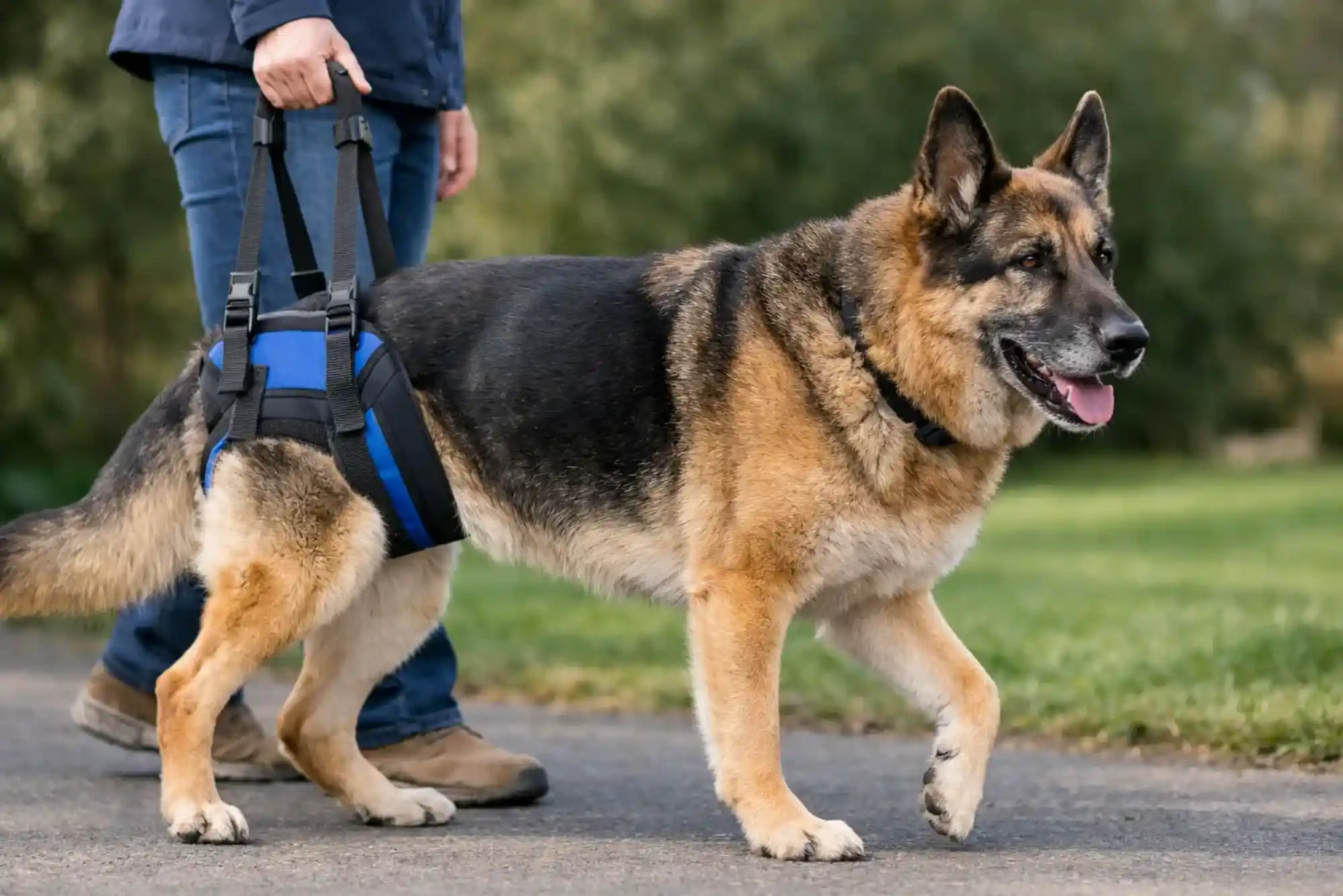
If your dog is a powerful puller, equipment can also make training safer and more manageable. A properly fitted harness may provide better control than attaching the leash to a collar, particularly when the dog becomes excited.
The equipment should support training rather than replace it. Even the best harness cannot teach a dog where to walk by itself.
Prevent Lunging at Dogs, People, and Distractions
Lunging is different from ordinary pulling. A dog may lunge because of excitement, frustration, fear, prey drive, or over-arousal.
When learning how to train a dog to walk beside a stroller, it is important to work on these reactions before exposing your dog to highly distracting environments.
Start at a distance where your dog can notice another dog or person without immediately lunging. Reward your dog for looking at the distraction and then returning their attention to you.
If your dog becomes too excited to respond, you are probably too close. Increase the distance and try again.
Do not wait until your dog is already barking and lunging before attempting to regain control. Watch for early signs such as staring, stiffening, slowing down, whining, or suddenly becoming intensely focused.
Recognizing these signals gives you time to redirect your dog before the reaction escalates.
Add the Stroller to Real-World Distractions Gradually
Once your dog can walk calmly beside the stroller in a quiet environment, gradually introduce more realistic conditions.
You might begin with a quiet residential street before moving to a busier sidewalk. Later, you can practice around bicycles, other dogs, children, traffic sounds, and people passing at different speeds.
Do not increase every difficulty at once. If you introduce a crowded park, unfamiliar dogs, heavy traffic, and a moving stroller simultaneously, your dog may become overwhelmed.
Successful training should progress at a pace your dog can handle.
This gradual approach is particularly important for puppies and dogs that are easily overstimulated. A calm five-minute practice session is often more valuable than a 30-minute walk filled with repeated lunging and corrections.
Practice Stopping, Starting, and Turning
Real stroller walks rarely involve walking in a perfectly straight line. You will need to stop at crossings, turn corners, avoid obstacles, and occasionally change speed.
Teach these skills deliberately.
Practice stopping the stroller and asking your dog to remain beside you. Reward calm behavior before starting again. Then practice slow turns in both directions.
If your dog cuts across the stroller’s path when you turn, stop and reset. Over time, your dog will learn to anticipate that changes in direction mean they should stay attentive to you rather than rushing ahead.
You can also practice short pauses where you stand still and ask your dog to wait calmly beside you. This is useful when crossing roads or dealing with unexpected obstacles.
Use Positive Reinforcement Consistently
Positive reinforcement is one of the most effective ways to teach reliable walking behavior. The reward does not always have to be food. Depending on your dog, praise, a toy, permission to sniff, or continuing the walk may all be valuable rewards.
At the beginning of training, reward desirable behavior frequently. As your dog becomes more consistent, gradually reduce the frequency of treats while continuing to reinforce good behavior through praise and access to enjoyable activities.
Timing matters. Reward your dog while they are performing the behavior you want, not several seconds later.
For example, if your dog walks calmly beside the stroller for several steps, mark that moment with praise and provide a reward. Your dog can then begin connecting the behavior with the positive outcome.
Keep Safety at the Center of Stroller Training
Safety should always come before completing a training session. Never attach the dog’s leash to the stroller itself. If the dog suddenly bolts, the stroller could move unexpectedly or tip.
Keep enough distance between the dog and the stroller wheels to prevent paws, legs, or the leash from becoming trapped.
It is also wise to avoid crowded areas until your dog has demonstrated reliable control. Busy sidewalks can introduce too many unpredictable triggers for a dog that is still learning.
Weather matters as well. Hot pavement can be uncomfortable or dangerous for dogs, while extreme heat can make exercise more demanding. Choose suitable walking conditions and provide appropriate breaks.
If an accident or medical emergency occurs during a walk, having access to an Emergency Pet First Aid Hub can help you identify appropriate veterinary support quickly.
For additional local pet-related resources, you can also explore Uaefinders.
What to Do If Your Dog Keeps Pulling
If your dog continues pulling despite consistent practice, return to an easier environment.
Training sometimes fails because owners progress faster than the dog can handle. A dog that walks perfectly in a quiet driveway may struggle dramatically around a busy park.
Reduce distractions and shorten the training session. Reinforce calm walking more frequently and gradually rebuild difficulty.
Consider whether your dog is receiving enough physical and mental exercise outside stroller walks. An energetic dog may find it particularly difficult to remain calm if they have not had an opportunity to release some energy.
However, avoid exhausting your dog simply to make them easier to control. The long-term goal is reliable behavior, not temporary fatigue.
If lunging is intense, unpredictable, or associated with fear or aggression, working with a qualified force-free trainer or veterinary behavior professional is a sensible next step.
How Long Does Stroller Walking Training Take?
There is no universal timeline for learning how to train a dog to walk beside a stroller. Some dogs adapt within several sessions, while others need weeks of gradual practice.
Age, temperament, previous leash experience, prey drive, social behavior, and the individual dog’s environment all influence progress.
Instead of focusing on a deadline, look for measurable improvements. Your dog may first learn to remain calm around a stationary stroller. Then they may walk beside an empty moving stroller. Eventually, they can handle normal walks with moderate distractions.
Consistency is more important than speed.
A few minutes of focused training several times a week can produce better results than occasional long sessions.
Common Mistakes to Avoid
One common mistake is introducing the stroller too quickly. A dog that suddenly finds the stroller moving behind them may become frightened or excited.
Another mistake is allowing pulling to continue because the owner is in a hurry. Every time pulling successfully moves the dog toward something interesting, the behavior can become more rewarding.
Owners should also avoid correcting lunging after the dog has already reached a high level of excitement. Prevention and early redirection are generally easier than trying to regain control after a reaction has escalated.
Finally, do not expect perfection immediately. Dogs learn through repetition. Small improvements should be reinforced, and setbacks should be treated as information about what training step needs adjustment.
Conclusion: Make Stroller Walks Calm and Predictable
Learning how to train a dog to walk beside a stroller takes patience, but the process becomes much easier when you break it into manageable stages. Begin with loose-leash skills, introduce the stroller while it is stationary, teach a consistent walking position, and gradually add movement and distractions.
The most important principle is to reward the behavior you want to see. Calm walking, a loose leash, attention to you, and appropriate responses to distractions should all lead to positive outcomes.
Do not rush into crowded environments simply because your dog succeeds in a quiet area. Build reliability gradually and prioritize safety every time you walk.
FAQs
How do I train my dog to walk beside a stroller?
Begin by teaching loose-leash walking without the stroller. Then introduce the stationary stroller, reward calm behavior around it, and gradually practice walking beside the moving stroller. Increase distractions slowly as your dog becomes more reliable.
How do I stop my dog from pulling while walking with a stroller?
Stop moving whenever your dog pulls and wait for the leash to become loose. Reward your dog when they return to the desired position, then continue walking. Consistency helps your dog learn that loose-leash walking makes the walk continue.
Can you walk a dog while pushing a baby stroller?
Yes, provided the dog has appropriate leash skills and can remain safely away from the stroller wheels. Practice in controlled environments before attempting busy streets or crowded public areas.
How do I stop my dog from lunging at other dogs while walking?
Maintain enough distance from other dogs that your dog can remain calm. Reward them for noticing another dog and then focusing back on you. Gradually reduce the distance only when your dog can remain relaxed.
Should my dog walk in front of or behind the stroller?
Your dog should remain in a predictable position beside you without crossing directly in front of the stroller. The safest position depends on your walking environment, stroller design, and your dog’s behavior, but avoiding the wheel path is essential.
How long does it take to teach a dog to walk nicely on a leash?
The timeline varies significantly between dogs. Dogs with previous loose-leash experience may improve quickly, while strong pullers or highly reactive dogs may require several weeks or longer. Consistent short sessions are usually more effective than rushed training.
What should I do if my dog is afraid of the stroller?
Start with the stroller stationary in a familiar environment. Allow your dog to investigate voluntarily and reward calm behavior. Avoid forcing the dog toward the stroller. Once your dog is comfortable, introduce small movements gradually.
Related Reading: Best Heavy Duty No-Pull Harnesses for Pitbulls, Boxers, and Strong Pullers
Related Reading: المايونيز: طريقة سهلة وفعالة
Related Reading: الكائنات الحية: شرح بسيط وواضح